In this video
If you run a digital agency, you've probably had clients ask about AI chatbots. Maybe you've thought about offering them yourself. The problem has always been the same: building a chatbot platform from scratch takes months of engineering and a team you probably don't have.
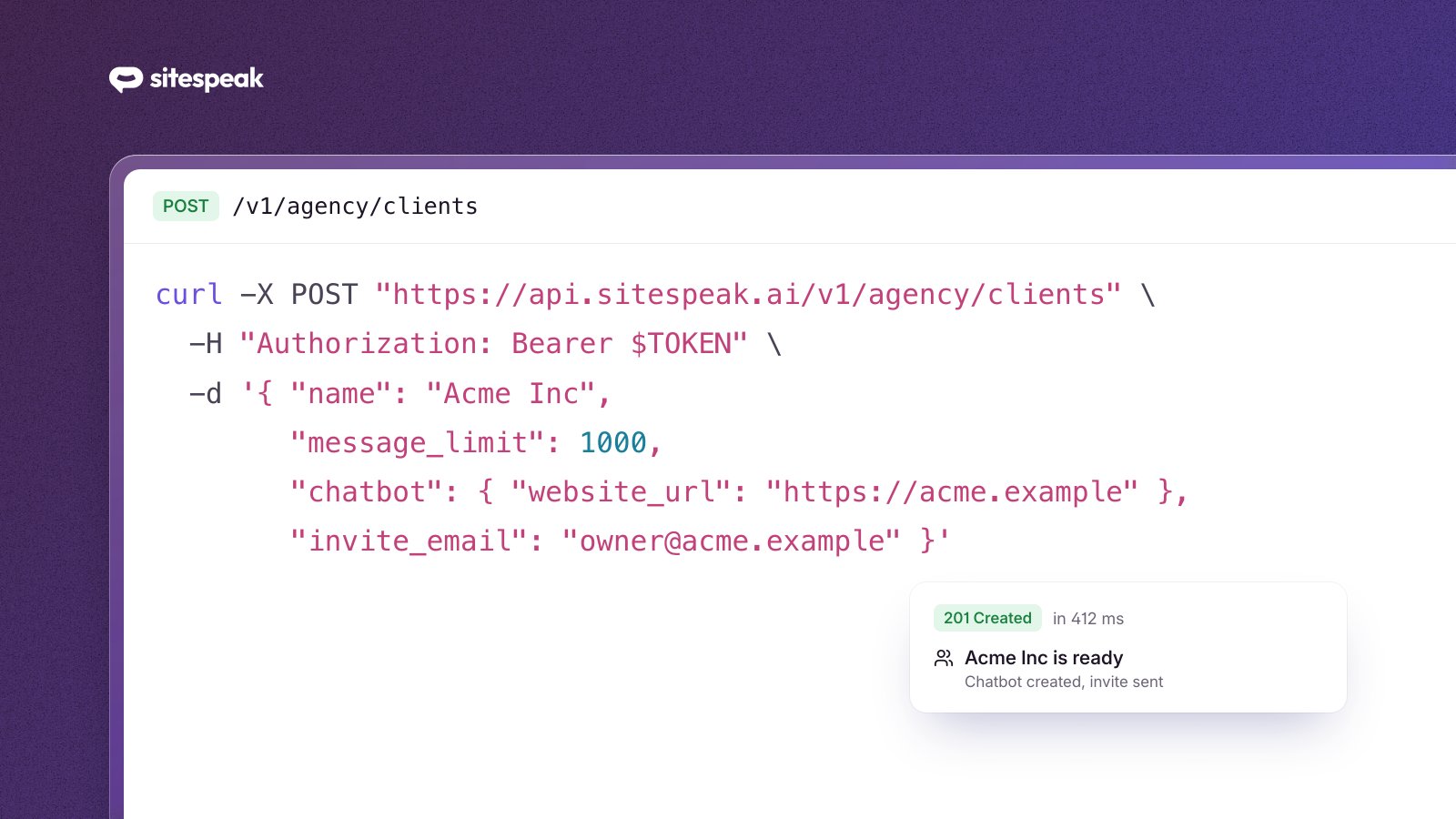
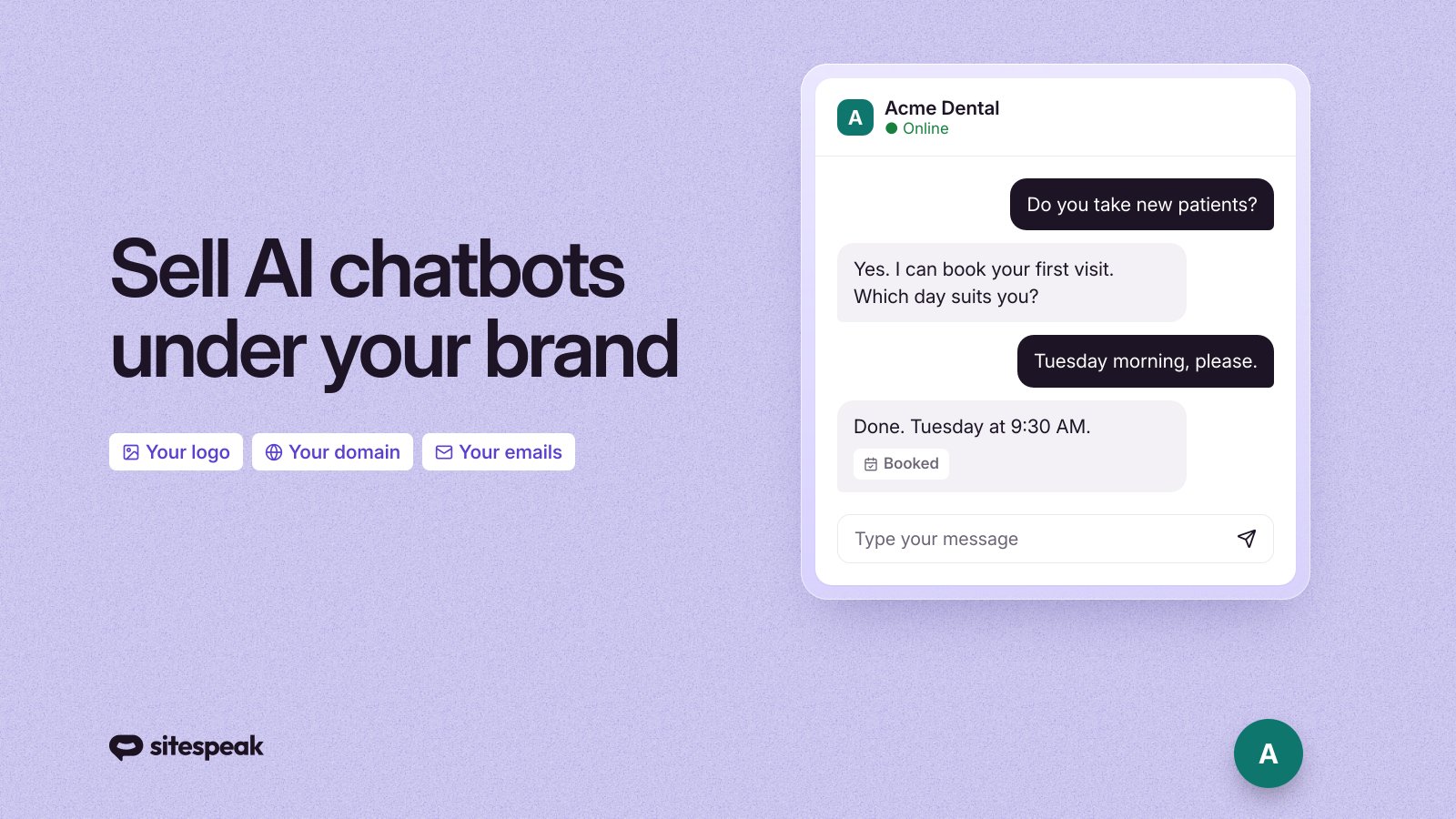
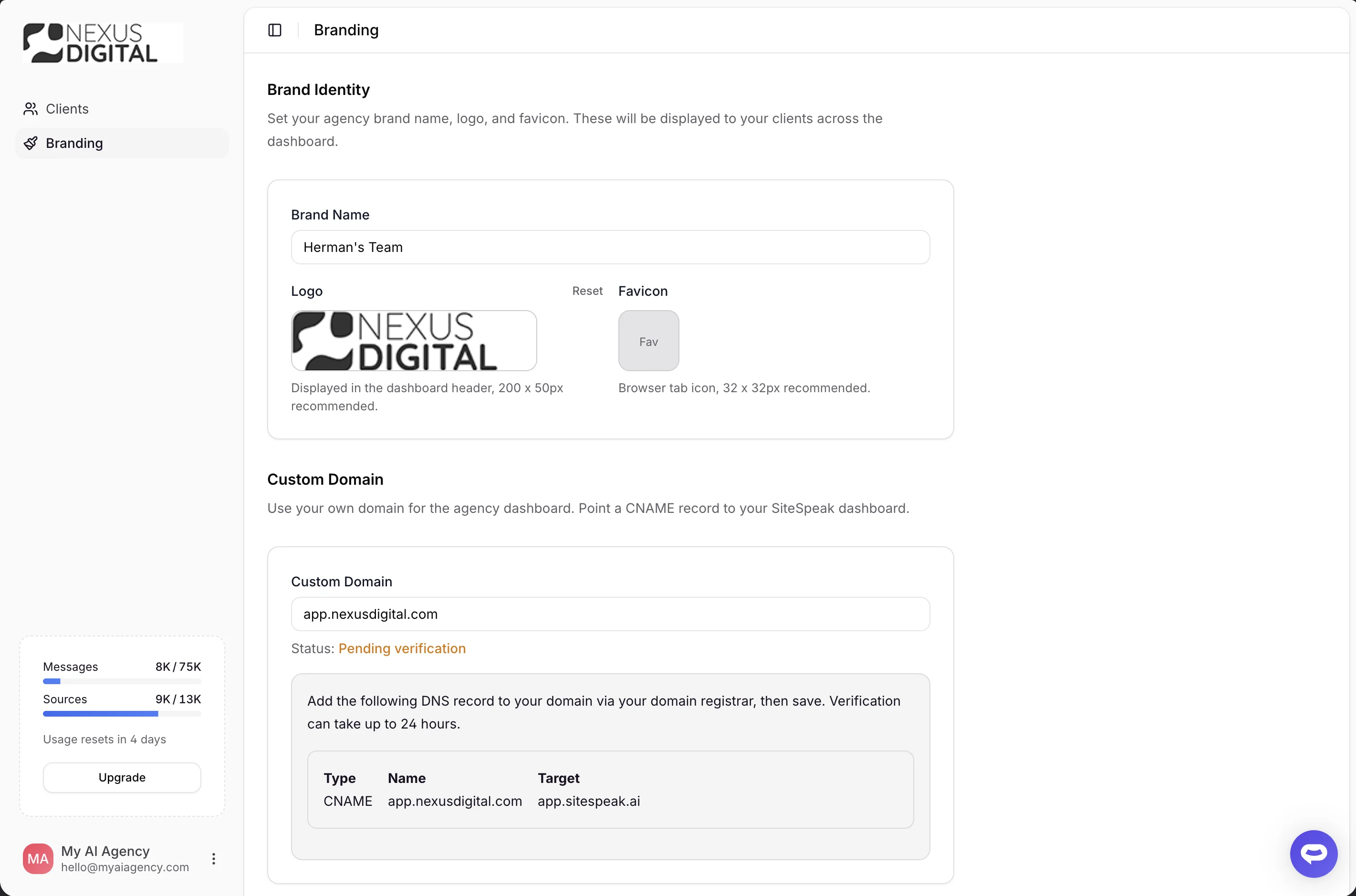
We built the SiteSpeak Agency & Reseller Program to fix that. It gives you a fully white-labeled AI chatbot platform under your own brand - your logo, your domain, your emails - so you can sell chatbots to clients without writing a line of code.
Here's what the program includes, why agencies are adding chatbots to their services, and how to actually sell them.
What the agency program includes
The agency program isn't a reseller discount. It's a complete white-label platform that removes SiteSpeak from the equation. Your clients never see our name.
Your own branded dashboard. Your clients see your logo and your branding when they interact with the platform. The dashboard can run on your own custom domain (something like app.youragency.com) with automatic SSL. From the outside, it looks like something you built yourself.
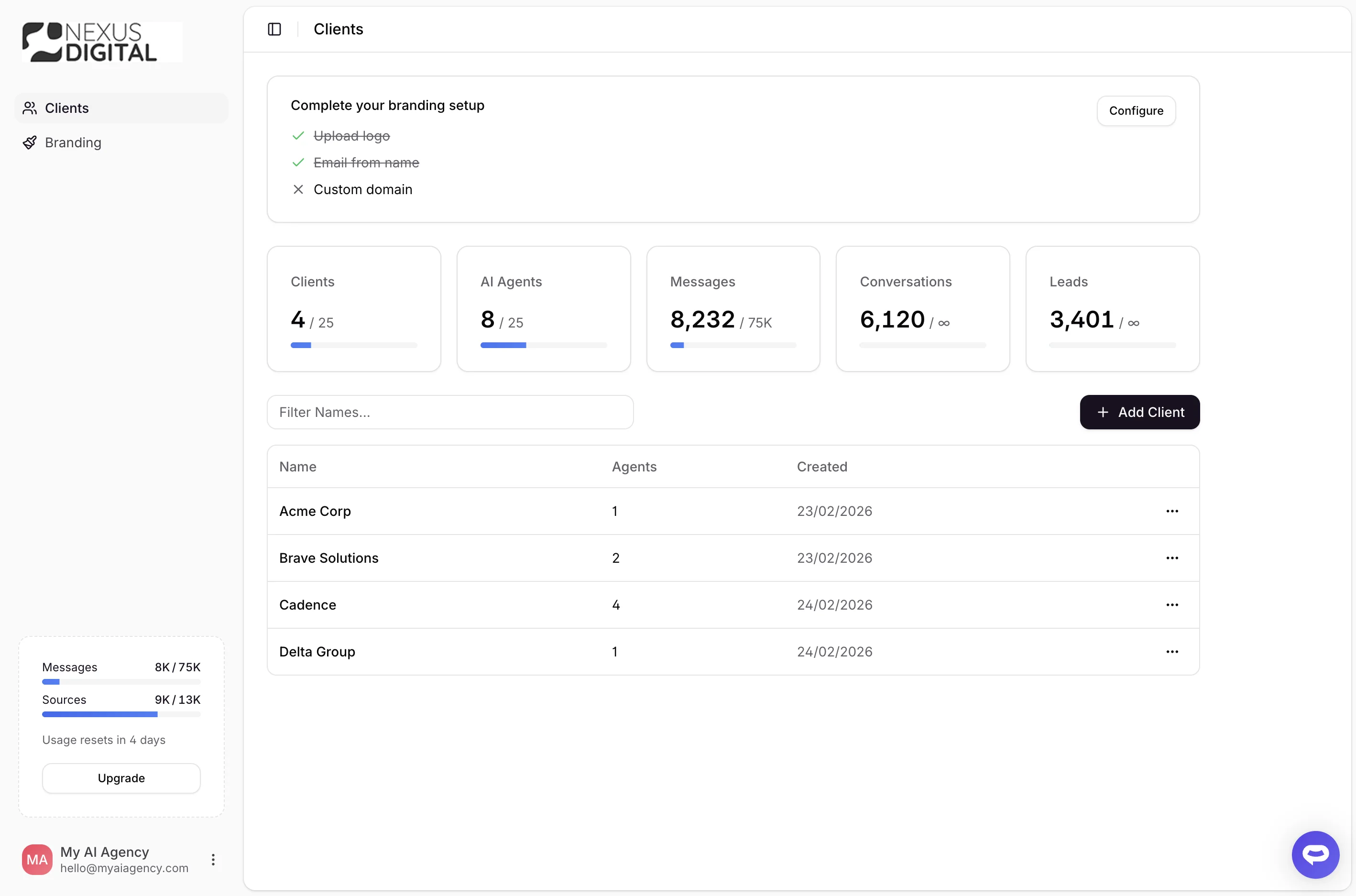
Branded emails. Every notification that goes out - lead capture alerts, conversation summaries, escalation notices - carries your agency's name and branding. You control the sender name and the sign-off. No "Powered by SiteSpeak" anywhere.
Isolated client workspaces. Each client gets their own separate workspace with their own chatbots, training sources, conversations, and leads. Nothing bleeds between accounts. You switch between them from a dropdown in your dashboard.
Team management. Invite your team members once at the agency level and they automatically get access to all client accounts. Three permission levels (Administrator, Editor, Member) let you give junior staff limited access while keeping full control yourself.
Custom domain with SSL. On the Pro and Enterprise plans, you can serve your entire agency dashboard on your own domain with automatic HTTPS. Your clients visit app.youragency.com, not app.sitespeak.ai.
Why agencies are adding AI chatbots to their services
There are a few practical reasons this is worth paying attention to.
It creates recurring revenue
Most agency work is project-based. You build a website, launch a campaign, deliver a report. Then you need to find the next project. Chatbots break that cycle by creating monthly recurring revenue.
You pay SiteSpeak a flat rate, charge your clients whatever makes sense for your market, and keep the difference. No revenue share, no per-seat licensing to navigate.
The math is straightforward. On the Starter plan at $399/month, you can manage up to 10 client chatbots. If you charge each client $150/month for their chatbot (a reasonable rate for a small business), that's $1,500 in monthly revenue against a $399 cost. The margins get better as you scale. The Pro plan at $699/month supports 25 clients.
Clients already understand what they're buying
AI chatbots aren't a hard sell anymore. Most business owners have used ChatGPT at this point. They get the concept. What they don't know is how to train a chatbot on their own website content and install it properly. You're not pitching abstract technology here. You're offering a specific solution to a problem they already recognize.
It makes your other services stickier
When you install a chatbot on a client's site and it starts capturing leads and answering customer questions, you've created something they rely on. They're less likely to drop your retainer when they can see the chatbot working every day in their analytics.
It also gives you something unexpected: access to what their visitors are actually asking. That conversation data is directly useful for content strategy, SEO keyword research, and writing better ad copy. One month of chatbot conversations tells you more about what a client's audience wants than most keyword research tools will.
Setup takes about an hour, not a week
The branding setup takes about five minutes. Creating a client workspace is a few clicks. Training a chatbot on a client's website content happens automatically when you point it at their sitemap. You can have a working demo ready for a client pitch the same afternoon.
How to sell AI chatbots to your clients
This is where agencies tend to get stuck. Building the chatbot is the easy part. Packaging and selling it takes a bit more thought. Here are four approaches that work well.
Bundle it with website projects. If you're already building or redesigning a website, include the chatbot as part of the deliverable. It increases your project value and gives you that recurring revenue once the project wraps. Clients see it as a natural part of a modern website, not an upsell.
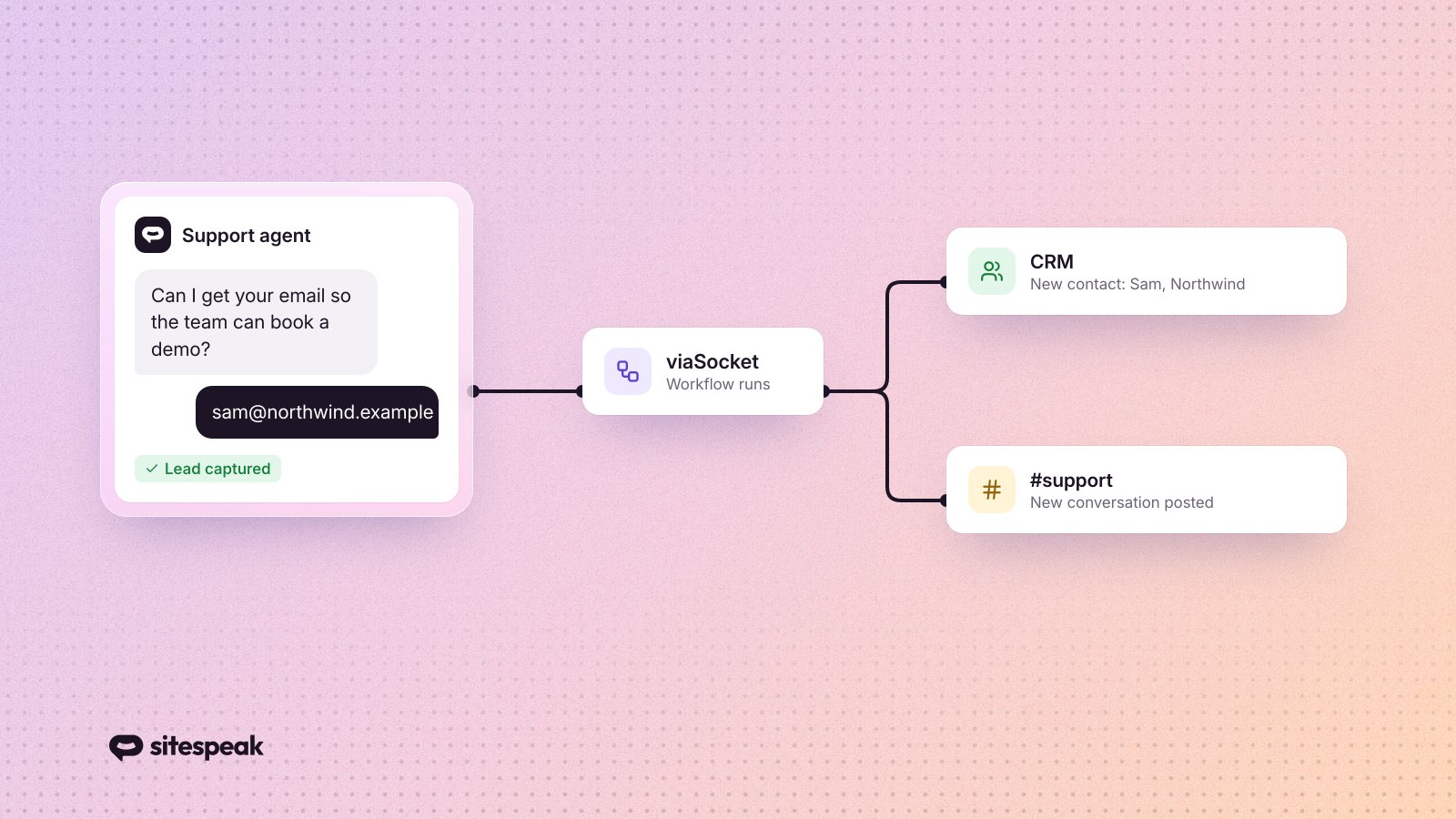
Lead with lead capture. For clients who care about generating leads (which is most of them), pitch the chatbot as a smarter alternative to a contact form. Instead of a static form sitting on a page, the chatbot has a conversation, qualifies the visitor, and captures their details with context. That framing resonates more than "we'll add AI to your site."
Use conversation data as a monthly upsell. After a chatbot has been running for a month, you'll have a log of every question visitors asked. That's a content roadmap you didn't have to research yourself. Offer a monthly review of chatbot conversations as part of your retainer, with recommendations for new pages, FAQ updates, or ad copy adjustments.
Run it as a standalone service. Some agencies treat the chatbot offering as its own product line, separate from their design or development work. A dedicated landing page, a simple pricing structure, and a working demo chatbot are enough to start bringing in leads for this service specifically.
What powers the chatbots
The chatbots run on a RAG (Retrieval Augmented Generation) pipeline. In practical terms, they actually read your client's website content before answering visitor questions. The system crawls the site, breaks the content into chunks, stores it in a vector database, and retrieves relevant sections when someone asks a question. That means answers are grounded in real content, not hallucinated from general training data.
You get access to multiple AI models including Claude Sonnet 4.5, GPT-5.2, and Gemini 2.5 Flash. There's also built-in lead capture, human handoff when conversations need a real person, WhatsApp integration, and a shared inbox for monitoring conversations across all your clients from one place.
Pricing
Three plans, all with a 7-day free trial:
- Starter ($399/month): 10 clients, 10 AI agents, 25k message credits, full white-label branding.
- Pro ($699/month): 25 clients, 25 AI agents, 75k message credits, plus custom app domain. This is where most growing agencies end up.
- Enterprise ($1,299/month): Unlimited clients and agents, 150k message credits, dedicated support.
Annual billing saves about 17% across all plans.
The number worth focusing on is your per-client margin. On the Starter plan, charging clients $100-200/month each means you're profitable after two or three clients. Everything beyond that is margin you keep.
Getting started
The fastest way to go from reading this to having a working setup:
- Sign up for the free trial on any agency plan
- Upload your logo and set your brand name (takes about 5 minutes)
- Create your first client workspace
- Point the chatbot at a client's website sitemap and let it train
- Demo it
That whole process takes about an hour. Once a client sees their own content coming back as intelligent answers to visitor questions, the conversation about pricing tends to go pretty smoothly.