The 12 Best AI Visibility Tools in 2026
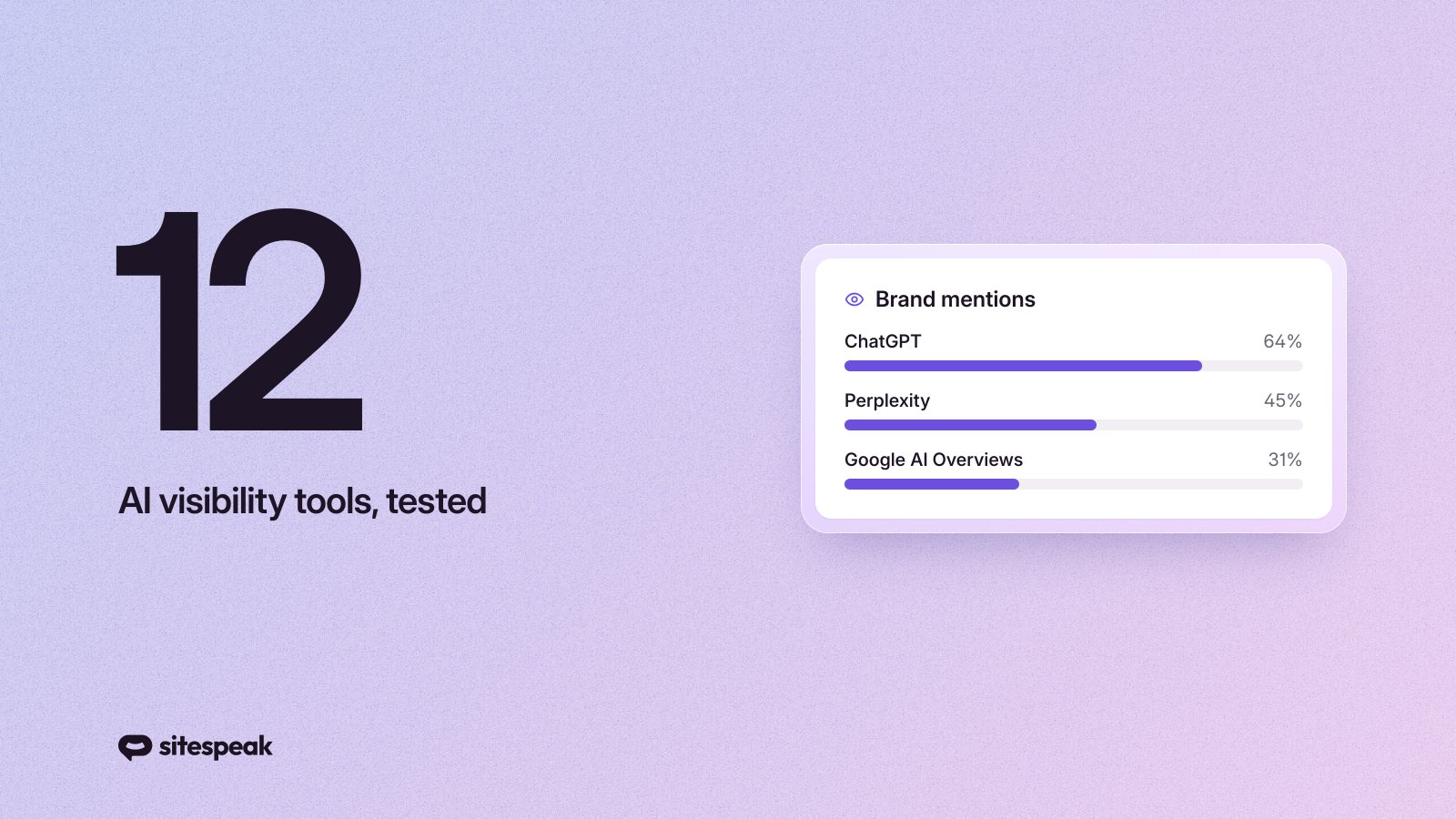
Customers now ask ChatGPT, Perplexity, and Google's AI Overviews questions that used to land on your homepage. Whether your brand shows up in those answers, or gets quietly skipped, is suddenly a measurable thing. "AI visibility tools" are the category that grew up around that question.
This guide compares 12 tools we have tested or shipped, with honest pricing, what each one is genuinely good at, and where they fall short. Full disclosure: tool number 1 is ours. We explain why we ended up building it below.
If you only have five minutes, the table at the top gives you the shortlist. If you want the why, keep scrolling.
What an AI visibility tool actually does
An AI visibility tool runs the prompts your buyers ask into AI engines on a schedule, then records whether the answer names your brand, which competitors it names instead, and which URLs it cites. Trackers report the symptom. Audit tools report the cause, which is usually a page that is blocked from being cited at all.
There are two halves to AI visibility, and most tools only cover one of them.
- Monitoring: tracks how often your brand and URLs are mentioned in AI answers across ChatGPT, Perplexity, Gemini, Google AI Overviews, Copilot, and Claude. Almost every paid tool in this guide lives here.
- Auditing: tells you whether your pages are technically eligible to be cited in the first place, measured against Google's official AI optimization guide.
You really need both. A monitoring tool that tells you your brand is missing from AI answers, but cannot tell you why, leaves you guessing. An audit that proves your pages are eligible, but never confirms whether they actually get cited in the wild, leaves you optimizing in the dark.
That gap is the reason we built AI Overview Checker. More on that in a moment.
Quick comparison table
Twelve tools. The free audit is $0. The cheapest paid tracker is Otterly.AI at $29 per month. The most expensive entry plan is Scrunch AI at $300 per month billed monthly. Three tools have a free plan that needs no other paid product: AI Overview Checker, MentionScout, and LLMrefs. Ahrefs Brand Radar is also free, but only with a paid Ahrefs account.
| Tool | Starts at | Free tier | Key feature | Best for |
|---|---|---|---|---|
| AI Overview Checker | Free | Yes, no signup | Audits against Google's official guide | Anyone publishing content |
| MentionScout | Free, from $59/mo | Yes, 1 brand / 10 prompts / 3 engines | 7 engines plus community listening | Monitoring and AI-crawler analytics in one |
| Ahrefs Brand Radar | Free with Ahrefs, from $50/mo standalone | Yes, with any paid Ahrefs plan | Largest prompt index | Existing Ahrefs users |
| Otterly.AI | $29/mo | Trial, length not stated | Cheapest paid entry | Solo marketers and small teams |
| LLMrefs | $79/mo | 7-day trial | Broadest named engine coverage | Keyword-first monitoring |
| ZipTie.dev | $69/mo | 14-day trial | Real-browser scraping | Verifying what users actually see |
| Semrush AI Visibility Toolkit | $99/mo per domain | No | Tight Semrush integration | Existing Semrush users |
| Peec AI | $80/mo | No | Fast iteration, mid-market focus | Mid-market brands with a marketer |
| GetMint.ai | $80/mo | Trial, no card | Tracking plus content drafting | Teams who also ship content |
| KIME | €99/mo | 7-day trial | Action Centre turns findings into a backlog | Teams that need pushing to act |
| Scrunch AI | $250/mo billed annually | 7-day trial | Fixes JS-rendering for AI crawlers | JavaScript-heavy sites |
| Profound | $99/mo billed yearly | No | Enterprise-grade depth | Enterprise teams that want the category leader |
Prices last checked 4 September 2026 against each vendor's own pricing page. Prices in this category move fast, so check before you commit.
Which engines does each tool track?
| Tool | ChatGPT | AI Overviews | AI Mode | Gemini | Perplexity | Claude | Grok |
|---|---|---|---|---|---|---|---|
| LLMrefs | Yes | Yes | Yes | Yes | Yes | Yes | Yes |
| MentionScout | Yes | Yes | Yes | Yes | Yes | Yes | Yes |
| Profound | Yes | Yes | Yes | Yes | Yes | Yes | Yes |
| Ahrefs Brand Radar | Yes | Yes | Yes | Yes | Yes | Enterprise | - |
| Scrunch AI | Yes | Yes | Yes | Yes | Yes | Yes | - |
| Otterly.AI | Yes | Yes | Add-on | Add-on | Yes | Add-on | - |
| Peec AI | Yes | Yes | Yes | Yes | Yes | - | - |
| Semrush | Yes | - | - | Yes | Yes | - | - |
| ZipTie.dev | Yes | Yes | - | - | Yes | - | - |
| GetMint.ai | Yes | Yes | - | - | Yes | - | - |
| KIME | - | - | - | - | - | - | - |
A dash means the vendor does not publish that engine, not that the tool cannot track it. Microsoft Copilot is the one engine kept out of the table: it is tracked by LLMrefs, Ahrefs Brand Radar, Otterly.AI, Peec AI, and Profound, and is the one major engine MentionScout does not track. Peec AI lists all of these engines but every plan below Enterprise tracks only 3 of them at a time. Semrush lists "Google AI" without saying whether that means AI Overviews, AI Mode, or both, so its Google columns are left blank here. Profound's row is its Enterprise coverage; Starter covers ChatGPT only and Growth covers ChatGPT, Perplexity, and AI Overviews. Scrunch AI also covers Meta. LLMrefs also covers Meta AI and DeepSeek. KIME publishes engine counts, 2 on Explorer and 3 on Core, but does not name the engines. AI Overview Checker is not in this table because it audits eligibility rather than tracking mentions.
The 12 best AI visibility tools
Most paid tools now track the same five or six engines, so coverage is not the thing that separates them. What they do with the data is. Scrunch AI fixes rendering. GetMint.ai drafts content. KIME builds an action backlog. MentionScout adds community listening and crawler analytics. Otterly.AI reports and stops there.
1. AI Overview Checker
What it does: runs 20 plus technical and content checks on any URL, scoring its eligibility to appear in Google's AI Overviews and AI Mode, with a prioritized fix list and links back to the Google docs that justify each check.
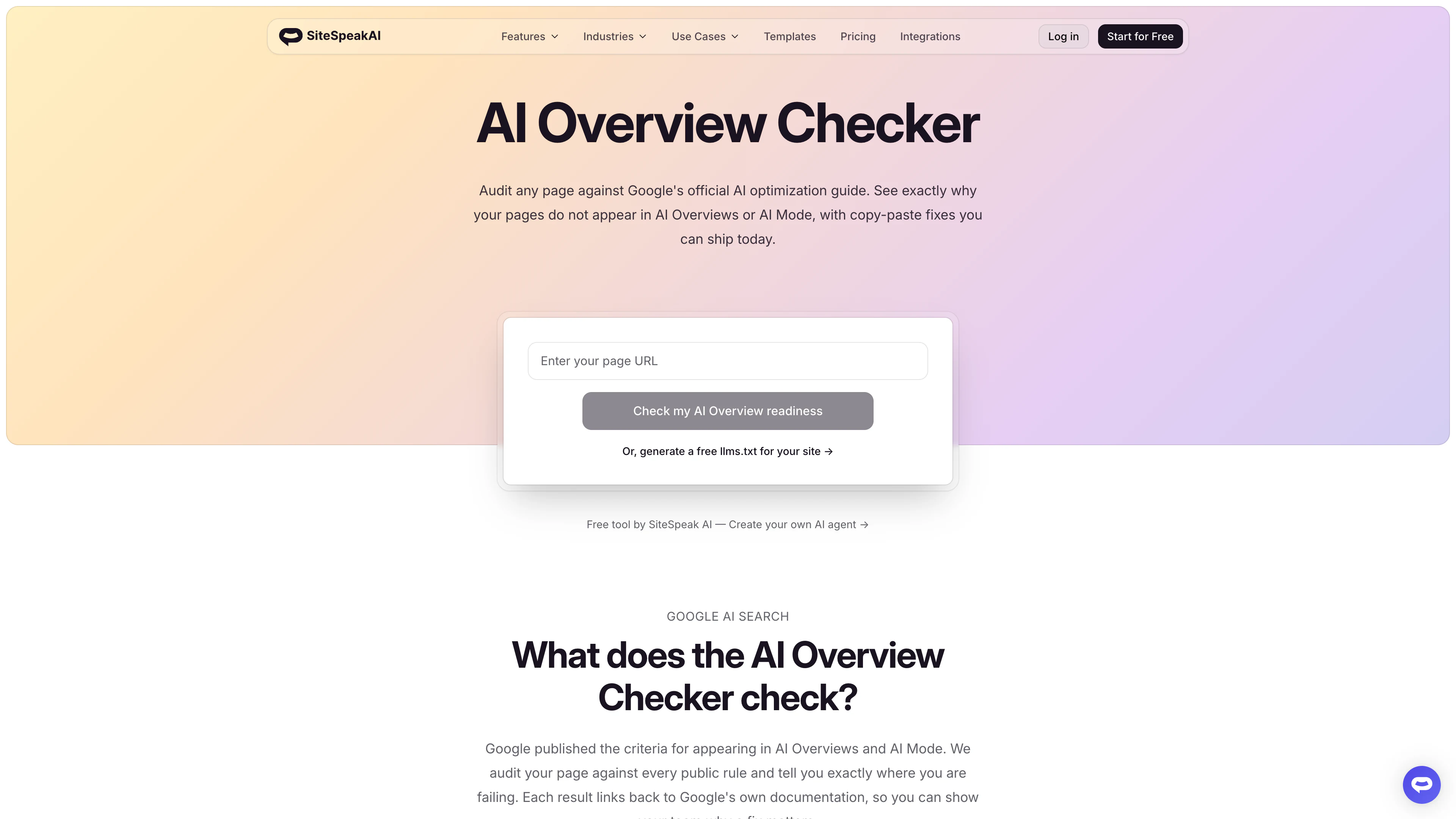
Pros: completely free, no signup for the scan, ships you the full report by email, weights eligibility blockers (nosnippet, max-snippet:0, accidental noindex) at 40% of the score because those are the silent killers most monitoring tools never surface.
Cons: audit only. It tells you whether your pages are eligible, not whether ChatGPT mentioned your brand last Tuesday. Pair it with one of the monitoring tools below.
Pricing: free.
Best for: anyone with a website that should be cited in AI answers but is not, and wants to know why before paying for a tracker.
The honest reason this is at position 1 is that we kept seeing audits where the brand was completely invisible in AI answers, the marketing team was buying monitoring software, and the actual cause was a stray max-snippet:0 left over from a launch year ago. The trackers told them they were not being cited. They could not tell them their pages were blocked from being cited at all. Run a free check here.
2. MentionScout
What it does: tracks how your brand shows up across seven AI engines (ChatGPT, Claude, Gemini, Perplexity, Grok, Google AI Overviews, and AI Mode) by running the real prompts your buyers ask on a daily schedule. It scores your visibility, ranks your share of voice against named competitors on every prompt, shows exactly which URLs each engine cites you in, flags the "answer gaps" where rivals appear and you do not, and tracks sentiment and average position alongside it all.
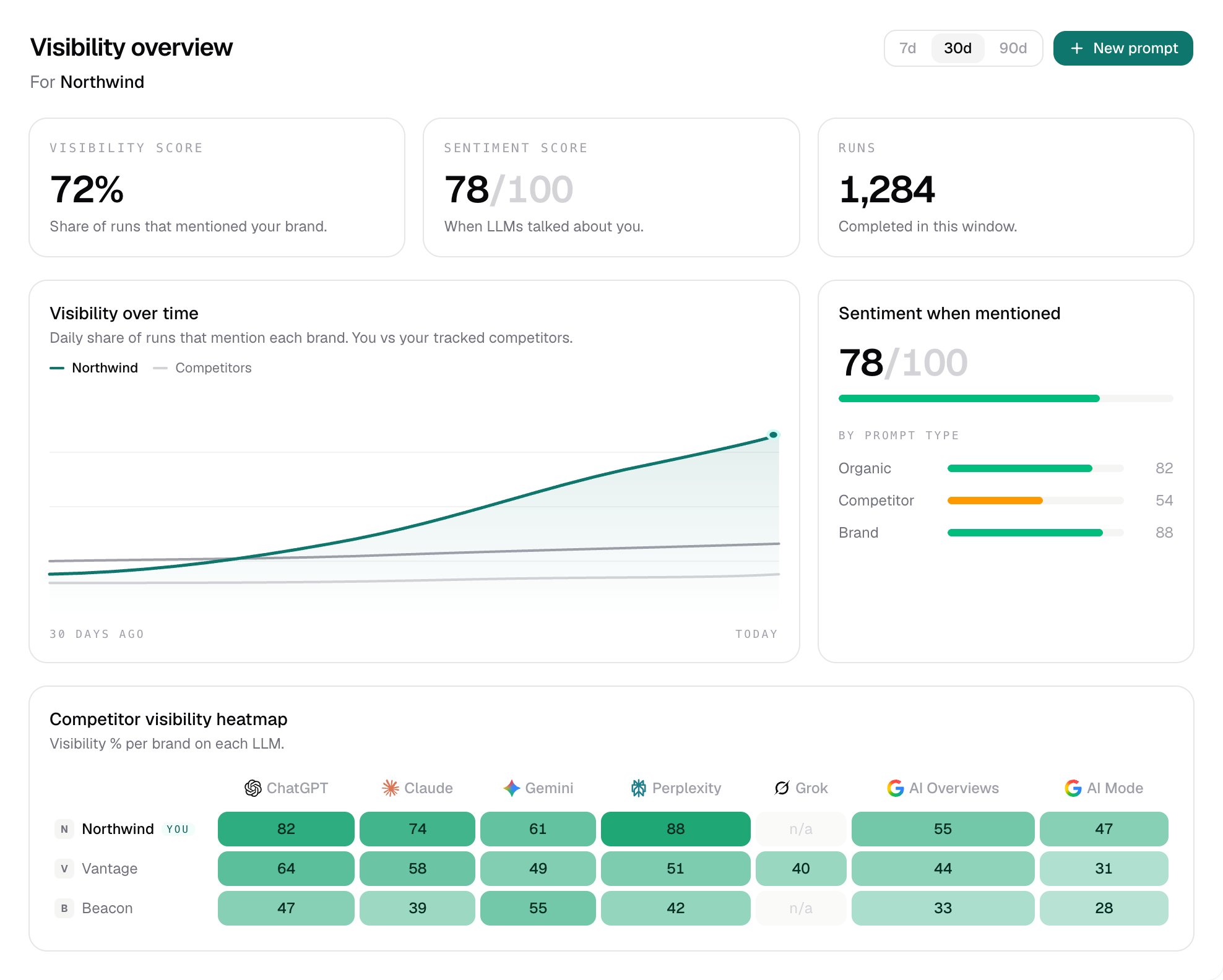
Pros: unusually broad for the price. Beyond mention tracking it adds two things most monitoring tools skip. The first is native community listening across Reddit, Hacker News, and Bluesky, with a flag for threads that AI answers already cite, so you can see the conversations shaping your visibility. The second is AI-crawler analytics: the Discovered to Crawled to Cited to Clicked funnel, which AI bots actually fetch your pages, and whether your robots.txt is quietly blocking them. Findings come back as ranked, evidence-backed recommendations rather than raw dashboards, and there is a genuine free plan to start on.
Cons: The free plan is capped at one brand, 10 prompts, three engines, and weekly checks; daily checks and all seven engines start on the paid plans.
Pricing: Free forever ($0); Starter $59/mo; Pro $149/mo (all 7 engines); Growth $299/mo; Scale $549/mo; Agency and Enterprise from $999/mo. 14-day free trial on every paid plan. Two months free on annual billing.
Best for: teams who want monitoring, community listening, and AI-crawler diagnostics in one dashboard without enterprise pricing. Take a look at MentionScout.
3. Ahrefs Brand Radar
What it does: plugs your brand into Ahrefs' index of more than 100 million prompts across Google AI Overviews, AI Mode, ChatGPT, Perplexity, Copilot, and Gemini, then shows where you appear, where competitors appear, and which pages are cited.
Pros: the prompt database is the deepest in the category, basic Brand Radar access is free with any Ahrefs account, and it integrates with traditional SEO metrics in one workspace.
Cons: the free tier is meaningfully limited. Custom prompts and broader engine coverage land between $50/mo and $699/mo as add-ons on top of an existing Ahrefs subscription.
Pricing: free Custom Prompts with any paid Ahrefs plan; standalone from $50/mo, up to $699/mo for all models. The separate AI Visibility Index is $199/mo and can be bought without an Ahrefs subscription.
Best for: teams already paying for Ahrefs who want AI visibility data without buying a second SaaS.
4. Otterly.AI
What it does: monitors brand mentions across ChatGPT, Perplexity, Google AI Overviews, and Microsoft Copilot, with prompt-level tracking and competitor benchmarking.
Pros: cheapest paid entry in the category at $29/mo for the Lite plan, well-documented dashboards, and used by enough marketing teams that public reviews are easy to find.
Cons: Lite is capped at 15 prompts. Google AI Mode, Gemini, and Claude are all paid add-ons. To get real coverage you need the $189/mo Standard plan, or $160/mo if you pay annually.
Pricing: $29/mo Lite; $189/mo Standard; $489/mo Premium; Enterprise from $1,000/mo. Annual billing saves 15%.
Best for: solo marketers and small teams who want to validate the category before spending mid-market money.
5. LLMrefs
What it does: tracks mentions and citations across 10 AI search systems: AI Overviews, AI Mode, Gemini, ChatGPT, Perplexity, Claude, Copilot, Meta AI, Grok, and DeepSeek, with a keyword-first interface.
Pros: the broadest named engine coverage in this guide at any price, a 7-day free trial, and a keyword-first model that maps cleanly to how SEO teams already think.
Cons: $79/mo for 500 prompts is fine value, but it assumes you already know which keywords to track. The free account's limits are not published on the pricing page.
Pricing: $79/month All in One, 500 prompts, all engines included. 7-day free trial.
Best for: teams that want a no-card-required starting point and a keyword-shaped mental model.
6. ZipTie.dev
What it does: queries ChatGPT, Perplexity, and AI Overviews using real browser sessions (not vendor APIs) and gives you full answer text plus downloadable screenshots, scored against an "AI Success Score" and citation share.
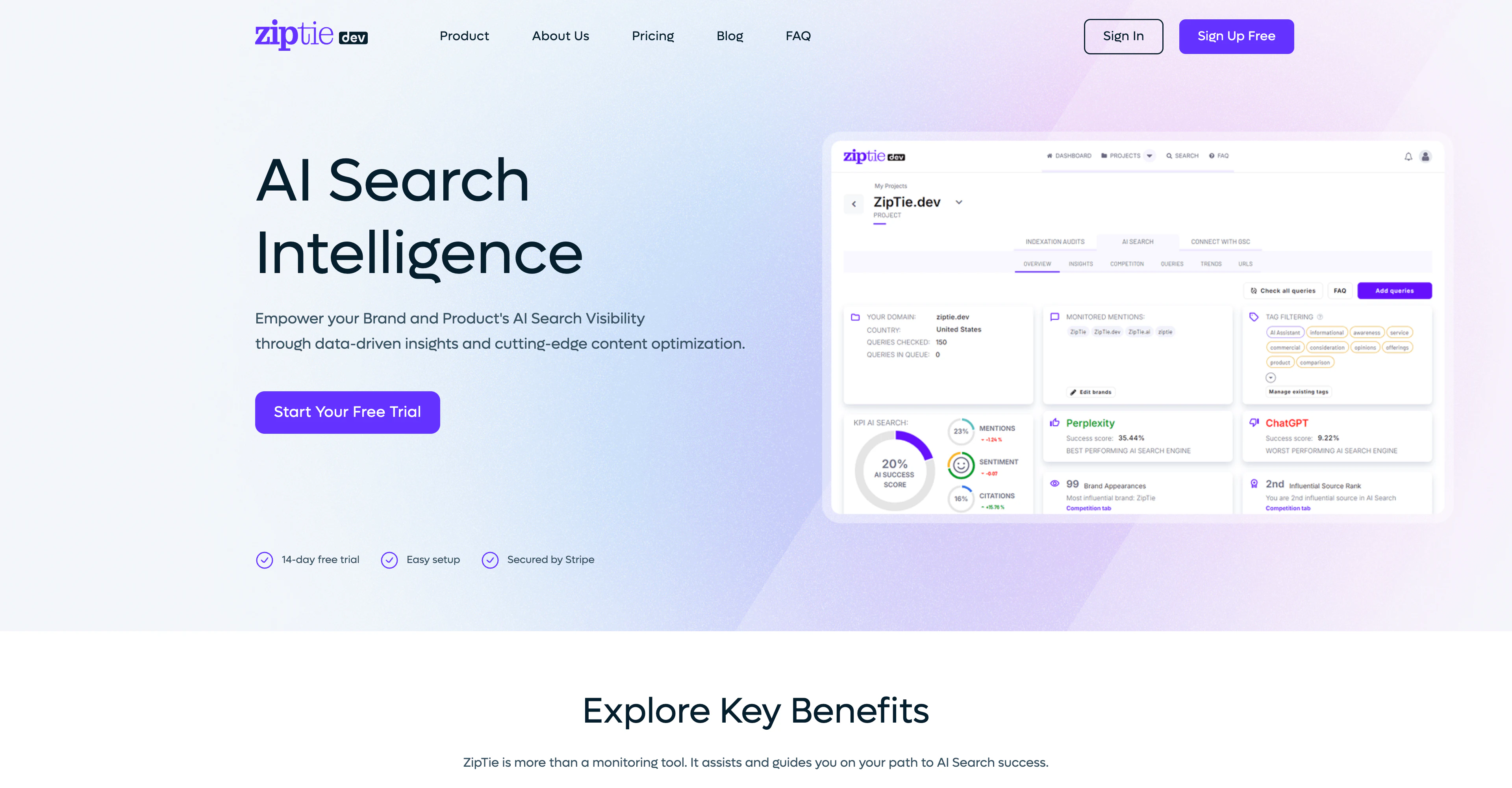
Pros: the real-browser approach catches the answer users actually see, including ads and personalization quirks API approximations miss. Built-in content optimization recommendations, not just metrics.
Cons: smaller engine coverage than KIME or LLMrefs. The real-browser method is slower to run at scale than API-based tools.
Pricing: $69/mo Basic; $99/mo Standard; $159/mo Pro; 14-day free trial.
Best for: teams who need legally defensible screenshots of what AI engines are actually showing.
7. Semrush AI Visibility Toolkit
What it does: tracks brand mentions across ChatGPT, Google AI, Gemini, and Perplexity, with prompt-level tracking, a site audit for AI readiness, and a Visibility Overview dashboard.
Pros: lives inside Semrush, so if your team is already there, the workflow lift is near zero. The dashboards are well-designed.
Cons: billing is per domain, so a second brand doubles the cost. The Base plan covers 25 custom prompts and one domain, which is thin next to what $99 buys elsewhere.
Pricing: $99/mo per domain, billed annually. Base includes 25 custom prompts with daily AI rankings and one domain for Brand Performance analysis.
Best for: existing Semrush users with one or two domains to track.
8. Peec AI
What it does: monitors brand presence across ChatGPT, Google AI Mode, Google AI Overviews, Microsoft Copilot, Perplexity, and Gemini, with a strong focus on speed of insight and mid-market workflows. Every plan below Enterprise lets you track 3 of those models at a time.
Pros: ships features fast (raised $29M in 2025 and visibly reinvests in product), Slack support on Pro, focused on the mid-market band that bigger tools ignore.
Cons: Starter, Pro, and Advanced all cap you at 3 models chosen from the list, so wide coverage means Enterprise and a sales call. Starter is also limited to a single project.
Pricing: $80/mo Starter (50 prompts, 1 project); $205/mo Pro (150 prompts, 2 projects); $420/mo Advanced (350 prompts, 5 projects); Enterprise custom, up to 12 models tracked. Prices shown are the annual rate. Unlimited users and daily tracking on every plan.
Best for: mid-market brands with a dedicated marketer who will actually act on the data.
9. GetMint.ai
What it does: combines AI visibility tracking (ChatGPT, AI Overviews, Perplexity) with a content studio that drafts and optimizes content directly inside the platform.
Pros: content drafting and brand-alignment scoring are not bolted on, they are first-class features. The AI search health audit checks for things like llms.txt presence and blocked bots.
Cons: if you only need tracking, you are paying for content tooling you may already have in your stack.
Pricing: $80/mo Starter (50 prompts, 2 engines); $349/mo Growth (300 prompts, 3 engines); Enterprise custom. Free trial, no card required.
Best for: content-led teams who need tracking and drafting in one place.
10. KIME
What it does: tracks AI models in real time and pairs the data with an Action Centre that converts the findings into a prioritized backlog of recommendations. Explorer covers 2 engines and Core covers 3, but KIME does not name which.
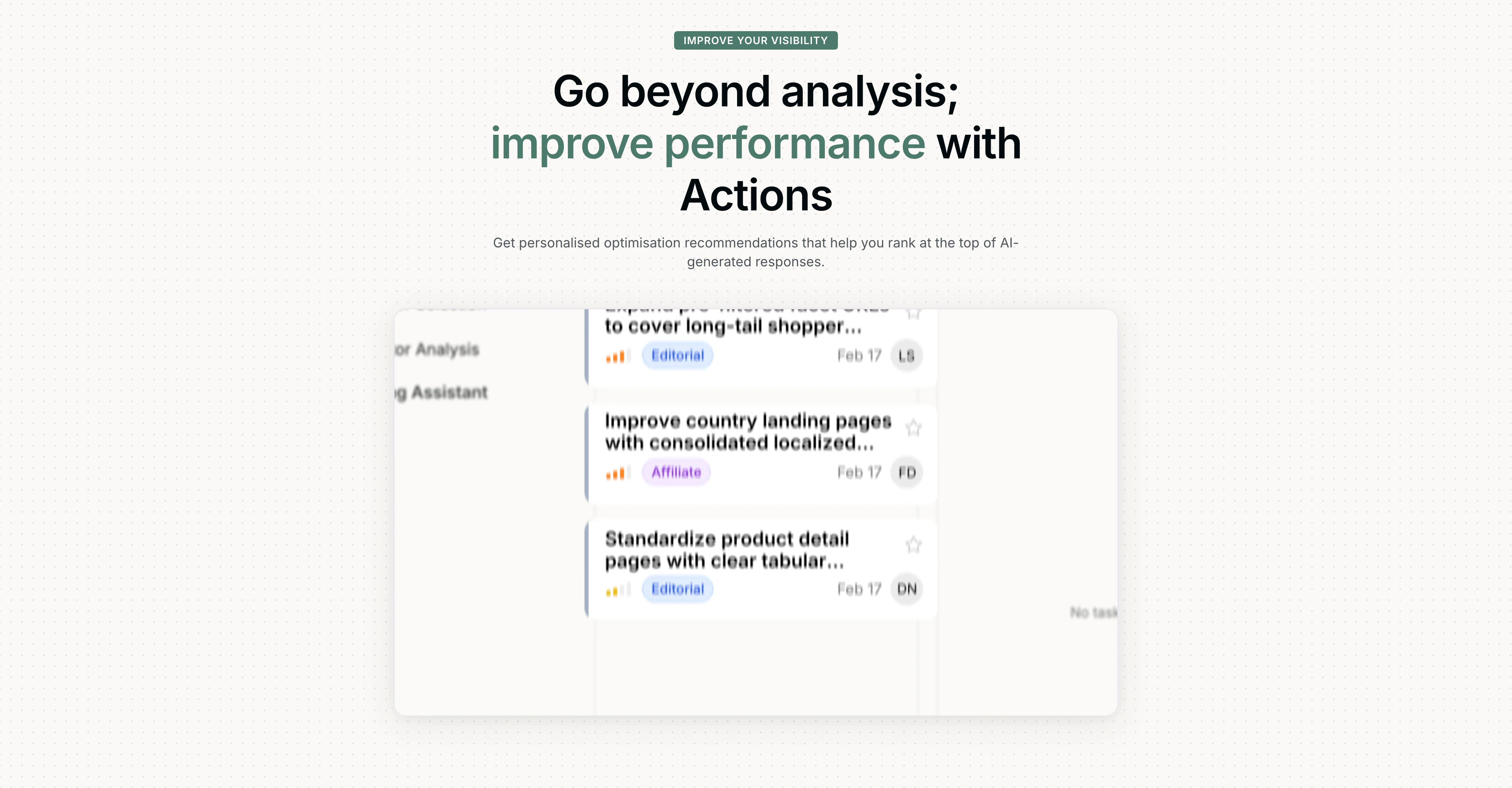
Pros: the Action Centre pushes teams toward doing something with the data instead of stopping at dashboards, and the 7-day trial needs no sales call.
Cons: engine coverage is thin for the money, 2 on Explorer and 3 on Core, and KIME does not say which engines those are. The Action Centre is genuinely useful, but you only need it if your team will follow through.
Pricing: €99/mo Explorer (50 prompts, 2 engines); €399/mo Core (200 prompts, 3 engines); Enterprise custom. 7-day free trial.
Best for: teams that want maximum engine coverage and a tool that nags them to act.
11. Scrunch AI
What it does: tracks brand presence across AI engines and, more distinctively, fixes JavaScript-heavy rendering issues at the CDN level so AI crawlers can actually parse your pages. Includes persona tracking by Ideal Customer Profile and funnel stage. Every plan covers ChatGPT, Claude, Gemini, Perplexity, Google AI Mode, AI Overviews, and Meta.
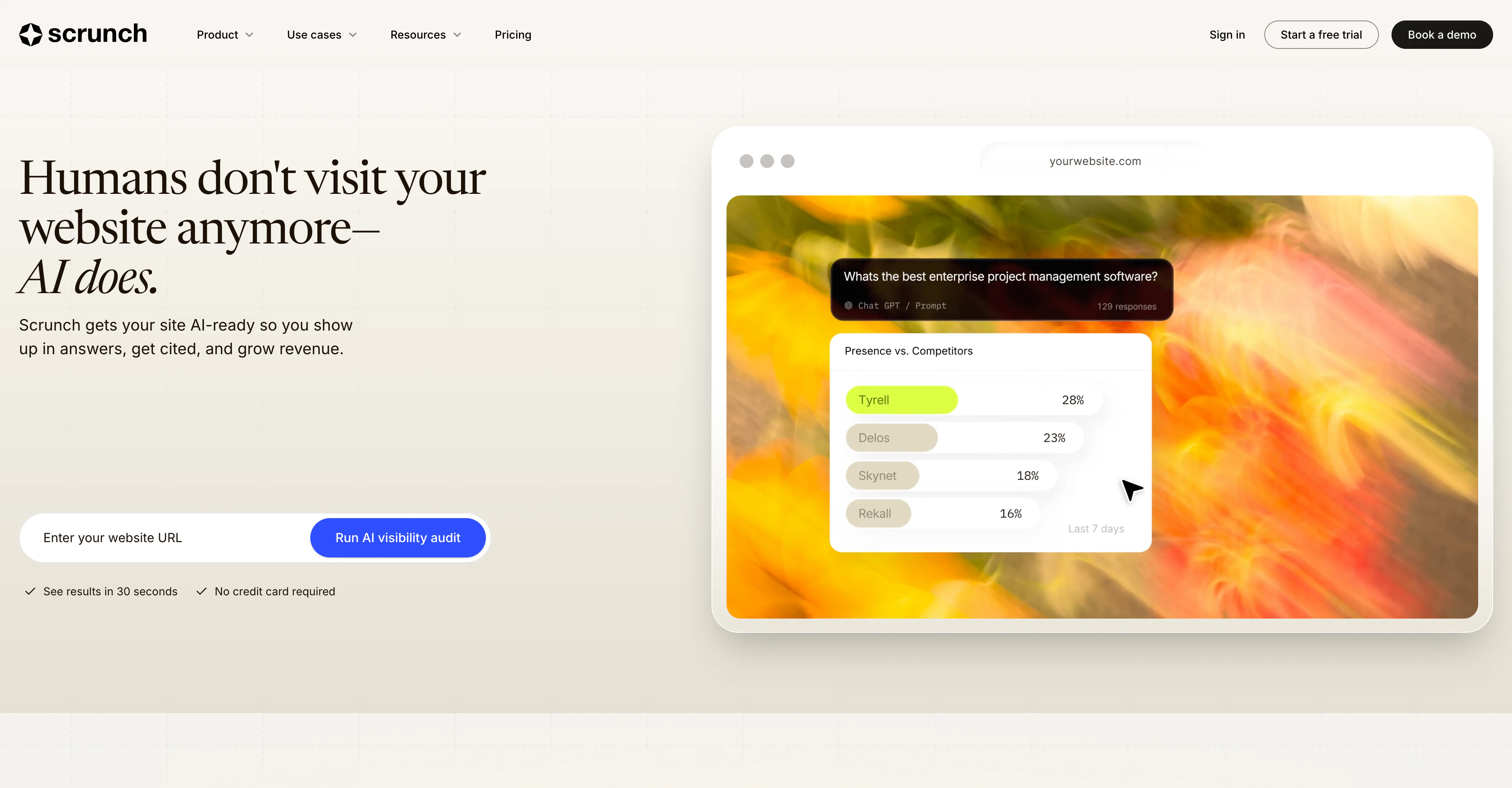
Pros: the only tool in this list that does meaningful technical remediation for JS-rendered content. Strong e-commerce features for tracking how SKUs surface in ChatGPT shopping.
Cons: no in-platform content editor, so optimization recommendations have to be shipped elsewhere. Entry price is the highest of the mid-market tools.
Pricing: Starter $300/mo monthly or $250/mo billed annually; Growth $500/mo monthly or $417/mo billed annually; Enterprise custom. 7-day free trial.
Best for: sites with heavy JavaScript rendering that are losing AI visibility because crawlers cannot see the page.
12. Profound
What it does: enterprise-grade brand visibility across ChatGPT, Gemini, Perplexity, Copilot, and others, with persona tracking, deep funnel breakdowns, and customer-tier onboarding.
Pros: the most depth at the top end of the market. Backed by $155M in funding, a billion-dollar valuation, and Fortune 500 reference customers.
Cons: Starter at $99/mo covers ChatGPT only, with 50 prompts. Growth at $399/mo covers three engines. Everything past that is a custom Enterprise contract, and Profound does not publish those numbers.
Pricing: $99/mo Starter and $399/mo Growth, both billed yearly; Enterprise custom, up to 9 answer engines.
Best for: enterprise marketing teams that want the category leader, though the $99 Starter plan now makes it worth a look for smaller teams tracking ChatGPT only.
What surprised us building our own tool
Three patterns we did not expect when we ran the AI Overview Checker against the first 50 customer domains we had access to:
Eligibility blockers are everywhere. On 11 of those 50 sites, a stray max-snippet:0 or accidental noindex was actively blocking pages the marketing team specifically wanted cited in AI Overviews. None of the monitoring tools had flagged it. They reported a symptom (low citation share) without ever pointing at the cause.
The myth surface is bigger than the rule surface. A surprising share of "AI SEO" advice on the open web (special llms.txt files as ranking factors, AI-specific schema types, content chunking for LLM consumption) is not in Google's official guide and is not how Google's AI features actually pick sources. We still ship a free llms.txt Generator because publishers want one for ChatGPT/Anthropic crawler hints, but it is not how you "rank" in AI Overviews. Google has been explicit about this in their own people-first content guidance.
Coverage is converging, opinion is not. Most of the paid tools above now track the same five or six engines. What actually differs is what they recommend you do with the data. Scrunch fixes rendering. GetMint drafts content. KIME pushes action items. Otterly just tells you. Choose for the recommendation engine, not the tracking surface.
How to actually choose
Strip away the marketing pages and the decision usually collapses to one of four buckets:
- No budget yet: combine AI Overview Checker (free audit), MentionScout's free plan (visibility score plus 10 prompts tracked across three engines), Ahrefs Brand Radar's free tier (monitoring snapshot), and LLMrefs' 7-day free trial. You will not catch everything, but you will catch the largest mistakes for $0.
- One budget line, want it all-in-one: Otterly is the cheapest way to get AI tracking on its own, without paying for a wider SEO suite you will not use.
- Existing SEO stack: Brand Radar if you are on Ahrefs, AI Visibility Toolkit if you are on Semrush. The integration savings beat switching costs.
- Mid-market with a real marketer: Peec, Scrunch, or MentionScout. Peec if your problem is awareness; Scrunch if your problem is your site does not render for crawlers; MentionScout if you also want community listening and AI-crawler analytics in the same view.
- Enterprise: Profound or a custom contract. Procurement will close that loop for you.
Whichever you pick, the prerequisite is the same: your pages have to be eligible to be cited before any tracker can show you results. If you have never audited your site against Google's published rules, do that first. It is the only step in this guide that is free and that, if you skip it, makes everything you spend on monitoring less useful.
Run the free audit
If you take one action from this post, run any URL on your site through the AI Overview Checker. It takes about a minute, surfaces the silent eligibility blockers most monitoring tools miss, and the full report (every check, recommendation, and Google source link) lands in your inbox.
Then pick whichever monitoring tool fits your budget from the list above. The combination is what works.
If you want to go deeper on the rules themselves, our AI Agent Readiness Scanner tests whether your site responds correctly to AI agents end to end, beyond just snippet eligibility. It is also free.