Last updated: July 29, 2026. All pricing verified against vendor pricing pages in July 2026.
TL;DR: AI customer service software answers customer questions automatically, using an AI agent trained on your content, and hands the hard cases to your team. We compared 12 tools on verified pricing, AI billing models, and what they cost at real volume. The short version: how a tool bills for AI matters more than its sticker price. At 1,000 conversations a month, verified pricing runs from $66 to $1,086 for the same workload, and two vendors on this list do not publish their AI rates at all.
Quick comparison
| Tool | Best for | Starting price | AI billing model |
|---|---|---|---|
| SiteSpeak | AI agent trained on your website, live in minutes | $24/mo | Message credits included in plan |
| Intercom (Fin) | Product-led SaaS teams on Intercom's inbox | $39/seat/mo | $0.99 per resolved outcome |
| Zendesk AI | Teams already standardized on Zendesk | $55/agent/mo (Suite) | Per automated resolution, rate not published |
| Freshdesk (Freddy) | Budget helpdesk adding AI | $19/agent/mo | 500 AI sessions included, then $49 per 100 |
| Tidio (Lyro) | Small ecommerce teams, chat-first | $24.17/mo | Lyro from $32.50 per 50 conversations |
| Chatbase | Quick site-trained chatbots | $32/mo | Message credits, $40 per extra 1,000 |
| Botpress | Developers who want flow control | $150/mo | Per conversation, AI spend included |
| Crisp | All-in-one inbox for small teams | $45/workspace/mo | AI credits bundled per plan |
| Help Scout | Email-first small teams | $25/user/mo | AI Answers at $0.75 per resolution |
| Gorgias | Shopify and ecommerce brands | $40/mo | $1.50 per automated interaction past quota |
| HubSpot Service Hub | Teams on HubSpot CRM | $7/seat/mo | |
| Ada | Enterprise deployments | Custom | Custom |
Prices are annual-billing rates unless noted. Every figure below comes from the vendor's own pricing page, checked July 2026, not from other roundups (several of which disagree with the vendors' actual pages).
How we evaluated
Full disclosure first: SiteSpeak is my product. I built it, I run it, and it sits first on this list. I have kept the criteria measurable so you can check my work, and I have listed the things SiteSpeak does not do further down. If you want a second opinion, G2's AI customer support category is a good place to start.
We scored each tool on four things:
- Time to a working agent. How long from signup to an AI agent answering real customer questions on your site.
- AI billing model. What you actually pay when the AI does its job. This is where the surprises live.
- Answer quality controls. Training on your own content, human handoff, and what happens when the AI does not know.
- Total cost at volume. Computed at a fixed scenario, in each vendor's own billing unit.
One number of our own, since almost every vendor quotes automation rates without showing their work: in a 90-day sample of customer conversations across several hundred live SiteSpeak deployments (April to July 2026), agents answered 88.5% of substantive questions. That figure comes from automated evaluation of every conversation, it excludes greetings and one-word inputs, and it excludes throwaway bots created by our free tools. It measures whether the question was answered, which is not the same as a vendor's "resolution rate", and the remaining 11.5% is why human handoff is a scoring criterion.
What AI billing actually costs at volume
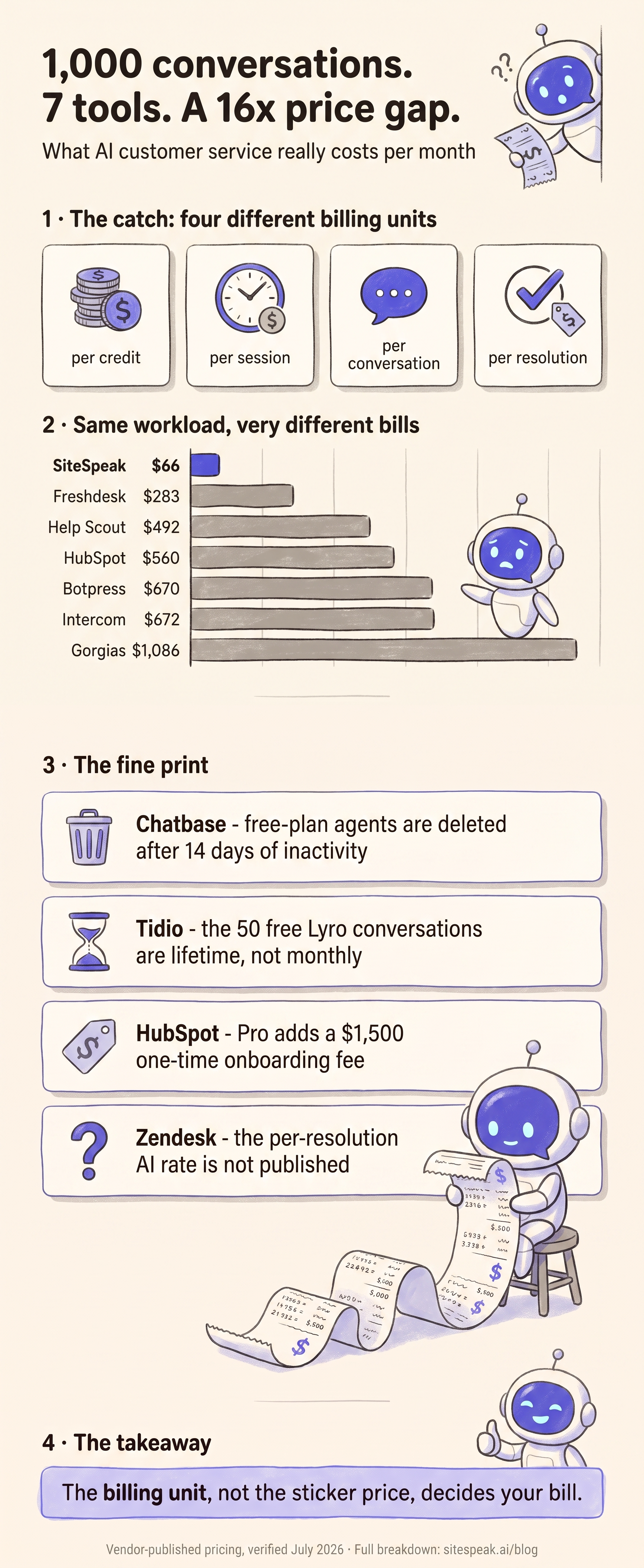
Vendors bill AI in four different units: per resolution, per conversation, per session, and per message credit. Sticker prices hide this. So we priced one fixed scenario across every tool with a published rate:
Scenario: 1,000 customer conversations per month, AI resolves 60% (600), two human agents for the rest, annual billing.
| Tool | Plan used | Monthly cost | The math |
|---|---|---|---|
| SiteSpeak | Pro, $66 | $66 | ~2,700 credits at our platform average of 2.7 credits per conversation, within Pro's 3,000 |
| Freshdesk | Growth, 2 agents | $283 | $38 seats + 500 AI sessions over the free 500 at $49/100 |
| Help Scout | Standard, 2 users | $492 | $42 seats (annual rate) + 600 resolutions x $0.75 |
| HubSpot | Service Hub Pro | $560 | $90 seat + ~47,000 credits over the included 3,000 at $0.010 each |
| Botpress | Plus | $670 | $150 base + 750 extra conversations in packs of 100 at $65 |
| Intercom | Essential, 2 seats | $672 | $78 seats + 600 outcomes x $0.99 |
| Gorgias | Pro | $1,086 | $471 base + 410 automated interactions over the included 190 at $1.50 |
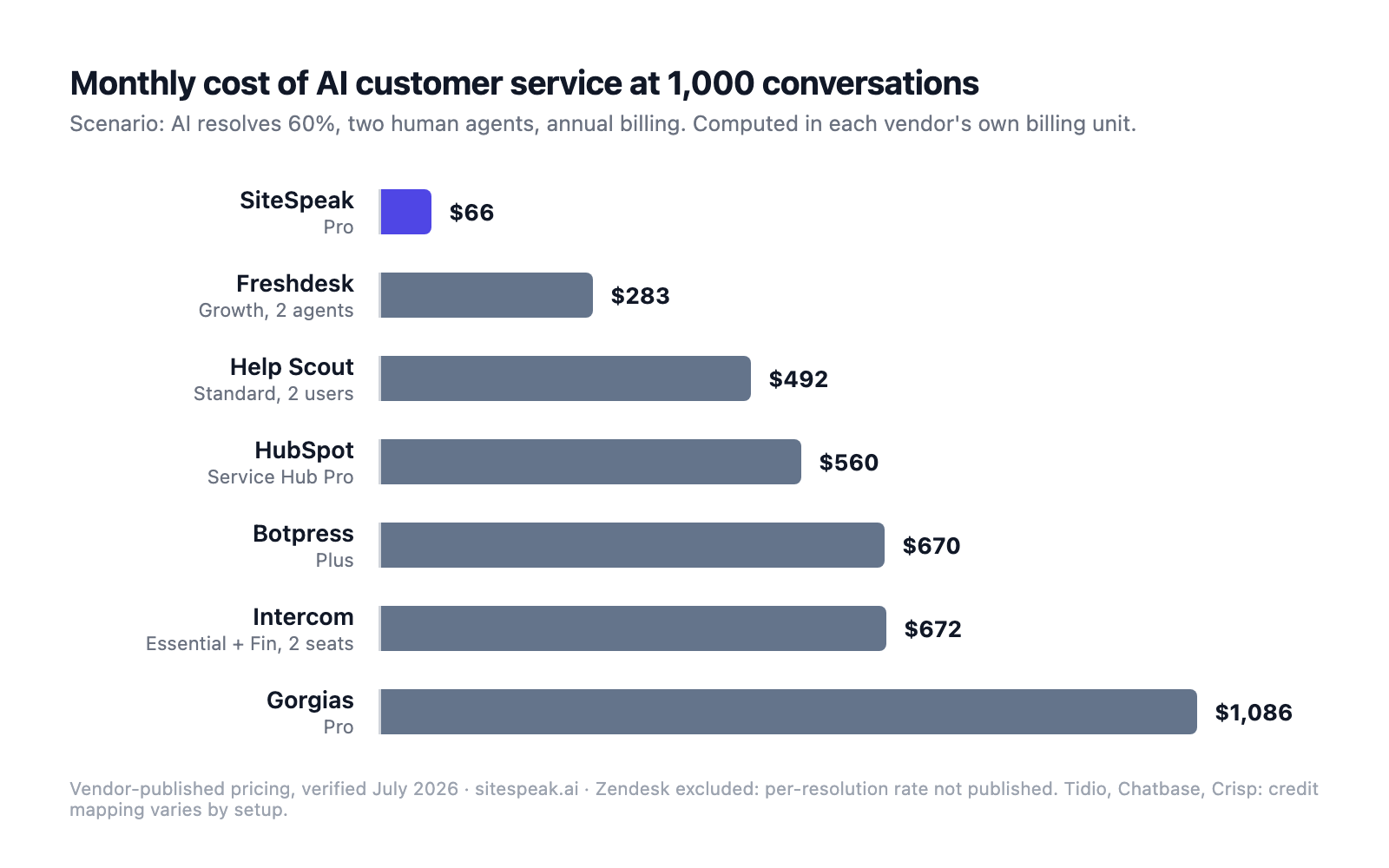
Not in the table: Zendesk bills per automated resolution but does not publish the rate, so budget for a sales call. Tidio, Chatbase and Crisp use credit systems where the cost per conversation depends on your setup, so a fair single number is not possible. Ada is custom-priced. HubSpot Pro also carries a one-time $1,500 onboarding fee.
Assumptions are listed above the table on purpose. Change them and the ranking shifts: at 100 conversations a month the spread narrows to almost nothing, and at 10,000 it widens further. Run your own volume through each vendor's unit before you commit.
The 12 best AI customer service software tools
1. SiteSpeak
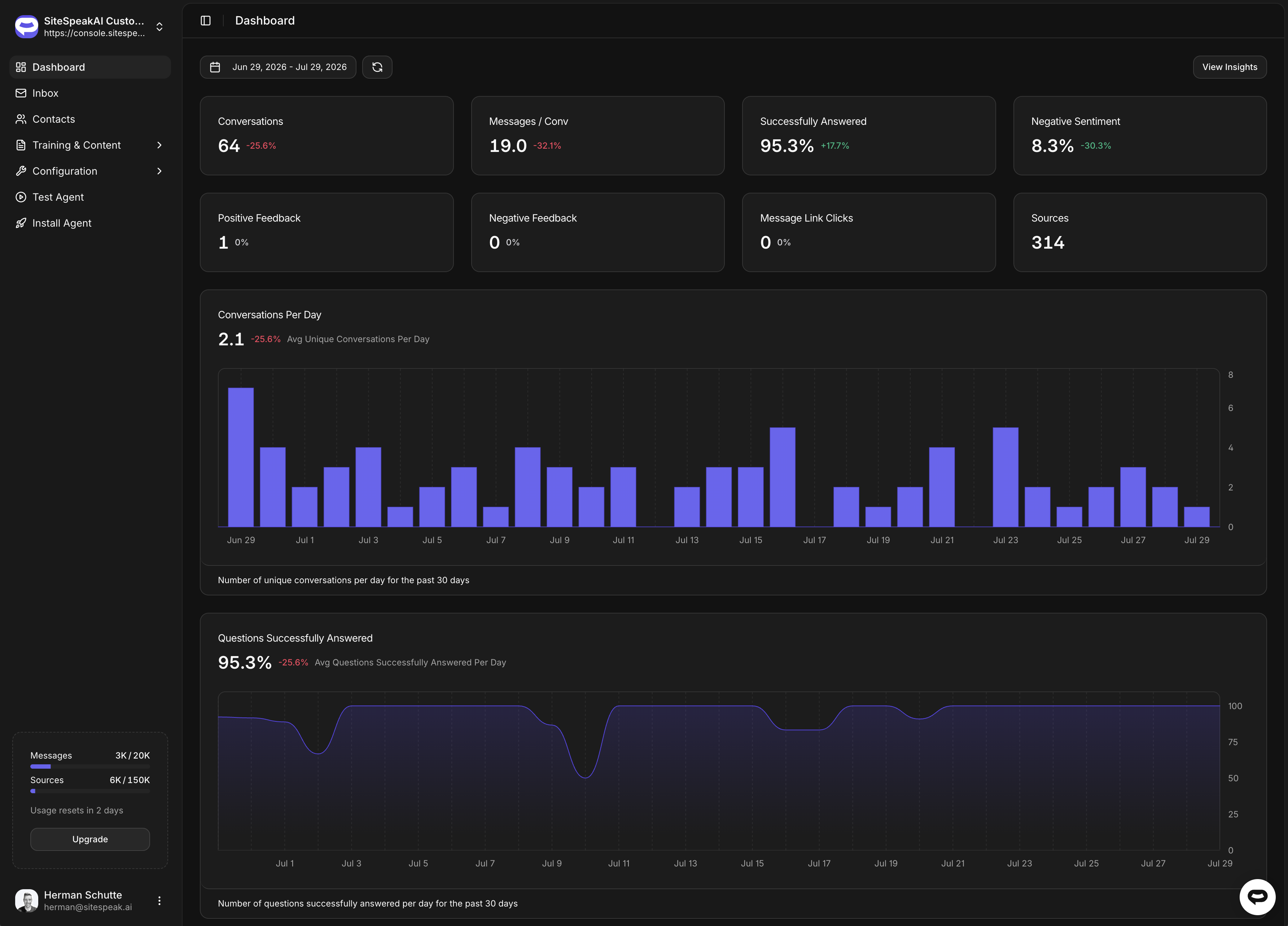
Best for: getting an AI agent trained on your website content live in minutes, without migrating your helpdesk.
SiteSpeak takes a different approach from most of this list. Instead of adding AI to a ticketing system, it starts with your existing website, help docs, and files, trains an AI agent on them, and gives you a widget to embed. There is no helpdesk to migrate onto and no per-seat pricing.
Key features:
- Trains on your website, help center, PDFs, Notion, YouTube, and more, with auto-syncing sources
- Choice of OpenAI, Anthropic, Google, and xAI models, with BYOK (use your own API keys) from the Pro plan
- Human handoff with a shared inbox, so the AI escalates instead of guessing
- Lead capture, WhatsApp, Slack, Discord, Zapier and HubSpot integrations
- API and MCP server access for custom setups
Pricing (checked July 2026): Free plan with 30 message credits. Starter at $24/mo (annual) with 1,000 credits. Pro at $66/mo with 3,000 credits, all AI models, BYOK, and human handoff. Growth at $208/mo and Business at $416/mo for higher volume. Extra credits are $25 per 1,000. 7-day trial on paid plans.
Where it wins: cost at volume (see the table above), speed to live, and model choice. If your support questions are answerable from content you already have, this is the shortest path.
Where it does not: there is no native voice channel. It is not a full ticketing system, so if you need SLA policies, workforce management, or deep multi-team routing, look at Zendesk or Freshdesk. The integration list is solid but much shorter than Zendesk's 1,200-plus marketplace.
2. Intercom (Fin)
Best for: product-led SaaS teams that live in Intercom's inbox and want outcome-based AI pricing.
Fin is the most polished AI agent on this list, and Intercom's bet on per-outcome billing is honest in one way: you pay $0.99 only when a conversation is resolved. The flip side is that a better bot means a bigger bill, and at volume it gets expensive fast. Fin also works standalone on top of other helpdesks, including Zendesk.
Pricing: Essential at $39/seat/mo annual ($49 monthly), Fin at $0.99 per resolved outcome with a minimum monthly commitment, Copilot for agents at $29/agent/mo extra. If the seat-plus-outcome math worries you, we keep a running comparison on our Intercom alternative page.
Watch for: outcome fees are charged when the customer confirms resolution, does not reply asking for more help, or Fin completes a handoff. Read the definition before you forecast costs.
3. Zendesk AI
Best for: teams already standardized on Zendesk that want AI inside their existing workflows.
Zendesk's AI agents come included with Suite plans and its admin tooling is genuinely deep. But the AI pricing is the least transparent on this list: automated resolutions are usage-priced and the rate is not on the pricing page, while the Copilot add-on that powers most of the agent-assist features is another $50/agent/mo on top of Suite.
Pricing: Support Team at $19/agent/mo, Suite Team at $55, Suite Professional at $115, all annual. Copilot add-on $50/agent/mo. Per-resolution AI rate: contact sales. More on the trade-offs on our Zendesk alternative page.
4. Freshdesk (Freddy AI)
Best for: budget-conscious teams that want a real helpdesk with AI included.
Freshdesk quietly has one of the fairest AI deals here: every plan includes 500 Freddy AI Agent sessions a month, and extra sessions are $49 per 100. Combined with $19/agent seats, it was the second cheapest tool in our volume scenario. The AI Copilot for agents is a $29/agent add-on limited to Pro and Enterprise plans.
Pricing: Growth $19, Pro $55, Enterprise $89 per agent/mo, annual. 14-day trial.
Watch for: "session" is Freshworks' own unit. Check how your conversation volume maps to sessions before trusting our scenario math.
5. Tidio (Lyro)
Best for: small ecommerce teams that want chat, flows, and AI in one cheap package.
In our own AI-visibility tracking, roughly 160 assistant runs per prompt, Tidio is the tool ChatGPT and other assistants recommend most often for small-business chat. The free plan is a real free plan, with one catch worth knowing: the 50 free Lyro AI conversations are lifetime, not monthly. After that, Lyro starts at $32.50/mo for 50 conversations a month.
Pricing: Free plan. Starter $24.17/mo, Growth from $49.17/mo, Plus from $300/mo, annual. Lyro AI is a separate usage line. Removing Tidio branding is another $16.67/mo on Growth. See how it compares on our Tidio alternative page.
6. Chatbase
Best for: spinning up a site-trained chatbot quickly on a credit budget.
Chatbase does one thing, does it fast, and prices it in message credits. The Standard plan at $120/mo with 4,000 credits covers a real small-business workload. Two things surprised us on the pricing page: AI agents on the free plan are deleted after 14 days of inactivity, and removing the "Powered by Chatbase" badge costs $1,188 a year, which is more than SiteSpeak's entire Starter plan.
Pricing: Free (50 credits), Hobby $32/mo, Standard $120/mo, Pro $400/mo, annual. Extra credits $40 per 1,000. We tested it head-to-head in our Chatbase alternatives roundup, and our Chatbase alternative page has the direct comparison.
7. Botpress
Best for: developers who want visual flow control and predictable per-conversation pricing.
Botpress made an argument we respect: it bills per conversation instead of per resolution, because resolution pricing "raises your bill when your bot gets smarter." AI spend (the LLM costs) is bundled in. The Studio builder is the most capable on this list if you want to design conversation logic yourself, and the free plan includes 100 conversations with three seats.
Pricing: Free, Plus $150/mo annual ($189 monthly) with 250 conversations, Team $750/mo ($939 monthly) with 1,500. Extra conversations in packs of 100 at $65 (Plus) or $50 (Team). Note that auto-recharge on overage cannot be turned off. Comparison on our Botpress alternative page.
8. Crisp
Best for: small teams that want chat, email, and a knowledge base in one workspace-priced inbox.
Crisp prices per workspace, not per seat, which makes it easy to budget: Mini at $45/mo includes 4 seats, Essentials at $95/mo includes 10. AI is metered in bundled credits that Crisp translates to roughly 90, 450, and 1,350 automated conversations on Mini, Essentials, and Plus respectively (their figures). The free plan covers two seats and unlimited conversations but includes no AI at all.
Pricing: Free, Mini $45, Essentials $95, Plus $295 per workspace/mo. 14-day trial. See our Crisp alternative page for the differences.
9. Help Scout
Best for: email-first teams that want simple, human support with AI as a helper.
Help Scout keeps the human in charge: AI Assist and AI Drafts help your team write, and the AI Answers agent is a $0.75-per-resolution add-on with a 3-month unlimited free trial, the most generous AI trial on this list. The free plan supports 5 users but caps at 100 contacts a month.
Pricing: Standard $25, Plus $45, Pro $75 per user/mo (monthly billing; annual saves 16%). AI Answers $0.75 per resolution on all paid plans.
10. Gorgias
Best for: Shopify and ecommerce brands that want support priced by ticket volume, not seats.
Gorgias is built for ecommerce and it shows, from Shopify actions to revenue analytics. Pricing is by ticket volume with unlimited agents, which is great until the AI meter starts: automated interactions beyond your plan's included quota cost $1.50 each, the highest per-unit AI price on this list, and it is why Gorgias came out most expensive in our volume scenario.
Pricing: Starter $40/mo (monthly billing only, 50 tickets, 30 automated interactions), Basic $77/mo annual (300 tickets), Pro $471/mo (2,000 tickets, 190 automated interactions), Advanced $1,227/mo. Ticket overages $0.36 to $0.40 each.
Watch for: as with Freshdesk's sessions, confirm what Gorgias counts as an automated interaction before trusting our scenario math.
11. HubSpot Service Hub
Best for: teams already running HubSpot CRM that want AI support in the same system.
If your company lives in HubSpot, Service Hub's Customer Agent is the path of least resistance, and at roughly $0.50 per AI conversation (50 credits at $0.010 each) the unit price is fair. The catch is the entry cost: Customer Agent needs a Professional seat at $90/mo, and Professional carries a mandatory $1,500 one-time onboarding fee.
Pricing: Free tools for 2 users, Starter $7/seat/mo annual, Professional $90/seat/mo plus onboarding. Our HubSpot alternative page covers when it makes sense and when it does not.
12. Ada
Best for: enterprises with the volume and budget for a custom-built AI deployment.
Ada is a serious enterprise platform with strong autonomous resolution numbers, and it is on this list because it keeps appearing in enterprise shortlists. There is nothing self-serve about it: pricing is custom, access starts with a booked demo, and public list prices do not exist. If you are reading a comparison post to pick a tool, Ada is probably not the tool you are picking today.
Pricing: custom only.
How to choose
Four questions cut through most of the noise:
What unit does the AI bill in? Per resolution ($0.75 to $0.99), per conversation, per session, or per credit. Take your real monthly volume, multiply it in the vendor's unit, and add the seats. The scenario table above is a starting point, not a substitute.
Can it answer from your content? Tools that train on your website and docs (SiteSpeak, Chatbase, Botpress) resolve the repetitive questions that make up most support volume. We wrote up the mechanics in how AI chatbots cut support ticket volume.
What happens when the AI does not know? An agent that escalates to a human with context beats one that improvises. Check for handoff before anything else, and test it with questions your docs do not answer.
Do you need the helpdesk, or just the answers? If you already have a ticketing system you like, an AI layer on your site may be all you need. If you need SLAs, routing, and workforce management, buy the helpdesk first and treat AI pricing as part of the total cost.
Frequently asked questions
What is AI customer service software?
AI customer service software uses large language models to answer customer questions automatically, usually through a chat widget trained on a company's website, help docs, and past conversations. Modern tools resolve routine questions on their own and hand complex ones to human agents with full context.
How much does an AI customer service bot cost?
Entry plans run $24 to $55 per month. The real cost driver is AI usage billing: per-resolution tools charge $0.75 to $0.99 per resolved conversation, per-interaction tools up to $1.50, and credit-based tools work out to a few cents per conversation. At 1,000 conversations a month, verified July 2026 pricing puts the spread between $66 and $1,086 per month.
What is the best AI tool for customer service?
It depends on where your support lives. For an AI agent trained on your website without a helpdesk migration, SiteSpeak (our product) is built for exactly that. For teams on Intercom's inbox, Fin. For Shopify brands, Gorgias. For a full enterprise helpdesk with AI included, Zendesk or Freshdesk.
Can I use ChatGPT for customer service?
Not directly: ChatGPT does not know your business and has no way to live on your website or hand off to your team. AI customer service tools use the same underlying models, add training on your content, and put controls around answers. SiteSpeak lets you bring your own OpenAI or Anthropic API key, which gets you ChatGPT-class models with your own usage billing.
SiteSpeak is our product, and it appears first on this list. Every price above links to the vendor's own pricing page so you can verify them yourself. Pricing changes: we recheck this post monthly, and the "last updated" date at the top reflects the most recent pass.